
Meaningful occupation is a life shaping force: A case study of recovery from chronic back pain.
Poster presentation paper : 2026 Australian Pain Society 46th Annual Scientific Meeting at the Adelaide Convention Centre, South Australia, 19 – 22 April 2026
Sasha Wray, Next Wave Therapy, O’Connor, Western Australia, sasha@nextwavetherapy.com.au
Katrina J Liddiard, School of Medical & Health Science, Edith Cowan University, Joondalup, Western Australia, k.liddiard@ecu.edu.au
Transforming the chronic pain trajectory through occupational therapy and a personally meaningful approach to rehabilitation.
BACKGROUND
This case highlights the transformative potential of a personally-meaningful approach to chronic pain care in the context of occupational therapy. When therapy is focused on meaningful occupational engagement, it can significantly alter the trajectory of a person’s life with persistent pain.1 The approach is grounded in meaningful occupation as a shaping life force: utilizing concepts of doing, being, becoming, and belonging. 2 This case reports on a comprehensive occupational therapy intervention, within a multidisciplinary team (MDT) context, for a client with chronic back pain.
CASE PRESENTATION
Belle*, a 61-year-old veteran, presented with a 23-year history of chronic lower back pain following spinal injury (L5/S1 disc bulge, facet arthropathy, and S1 nerve root impingement). Her complex presentation included post-traumatic stress disorder (PTSD), sleep disorder, and osteopenia. Despite extensive “usual” care, which included surgery, medication, physiotherapy and psychology, Belle continued to experience significant pain and disruption to her meaningful occupations.
INTERVENTION
Over six months, approximately weekly for the first 12 weeks and then fortnightly, occupational therapy was integrated into her MDT care alongside physiotherapy, psychology, and medication management.

Summary of therapy provided
- Enabling meaningful person directed occupational participation (performance and life satisfaction) with values guided goal setting, graded activity, hopefulness; and empowerment. In therapy this meant enabling past occupations that were not being done such as gardening and cooking and introducing new occupations such as yoga and volunteering.
- Pain specific education with emphasis on pacing and relaxation training.
- Mind-body approaches such as myofascial therapy, movement and mindfulness.
- Focused Psychological Therapy included trauma informed Acceptance and Commitment Therapy (ACT); assertiveness training; and grief / loss counselling.
- Genuine connection with therapist. Therapy done ‘with’ not ‘to’ the person.
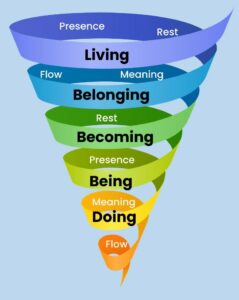
- Concepts of meaning, presence, flow and rest woven into life experience.
Approach and Models of Practice
The Pan Occupational Performance (POP) Paradigm 3 is a universal framework for occupational therapy (OT) focusing on how engaging in everyday activities (occupations) impacts health using four core dimensions: Doing, Being, Becoming and Belonging. 4
Occupational therapists help people by enabling them to do and to be, 4 and through the process of becoming in clinical practice. The synthesis of doing, being, and becoming is integral to the health and well-being of the individual.
- Doing “what you do” refers to occupations and occupational performance (actions, routines, habits, rituals).
- Being “who you are” refers to one’s sense of self and experience of self (values, self-efficacy, personhood, identity). It is about being true to self and the roles played.
- Becoming “how you grow” refers to personal growth and building competency. This is about potentiality and achievement of change over time, how a person sees one’s future, adapts, rethinks values and priorities to prepare for growth and self-actualization.
- Belonging “where you are” relates to a person’s connection to others, places and community and is positively correlated with human well-being.
Embedded into the treatment process were theoretical concepts of Complex Adaptive Systems (CAS) 5 and an understanding of what makes rehabilitation personally meaningful for people with chronic pain. Implicitly the therapist provided meaningful rehabilitation as “an experience of a genuine connection, with a credible therapist, who can act as a guiding partner to address what the client self-defines as personally valued and relevant to their self-identity”. 6
Explicitly, Belle’s complex adaptive systems were addressed via identifying:
- Repeating patterns (fractals) 7 in behavior or beliefs e.g. people pleasing and doing best.
- Attractor patterns 7 (keeping her stuck) e.g. routines and habits highly focused on pain management.
- Interacting & amplifying elements 7 e.g. holding no hope for change, where the best she hoped for was to be able to maintain bearable pain levels and prevent flare ups; an extended past experience of rehabilitation being done ‘to’ not ‘with’ combined with high guilt; and people pleasing meant a strong adherence to follow what others (professionals, friends, etc.) advised.
- Relational (perturbations) 7 or interventions shifting things toward more adaptation e.g. meaningful occupational participation.
Concepts of Meaning, Presence, Flow and Rest became hooks for integrating new behavior, patterns, attractors and amplifying elements during all moments of her life.
- Meaning – setting occupational goals grounded in values and purpose in life.
- Presence – noticing what is present and creating space for whatever is there.
- Flow – being physically and psychologically flexible to do what matters.
- Rest – an essential art of pain management which encompasses pacing principles for activity scheduling as well as letting go and being vulnerable.
OUTCOMES
The outcomes of this case show how personally meaningful rehabilitation can move beyond pain management toward a life transforming trajectory.
Therapist observation
Doing: Belle was doing her “best” to control pain. Her high commitment to therapy and exercise alongside a high-pressure work environment and caring for her unwell mother meant there was little time for self-care, socializing, home productivity and spending time with her immediate family. Post treatment she was empowered to do “just enough” with willingness to create the changes needed in routine, habits, roles, mindset, and self-talk.
Being: Prior to therapy, Belle had an extremely high level of protective behavior with equal ability for pushing through pain. This transformed into being flexible with a zest for life and increased self-efficacy.
Becoming: Once skills and willingness were established, Belle became creative in her response to pain. Prior to this, she was feeling trapped with an anticipated life of pain managed by rigidity in her body, thoughts, and routines. Her body posture softened, muscles relaxed, and she repeatedly reported how free and loose she felt.
Belonging: Belle had been living within a highly demanding social and work environment driven by guilt. Refocusing on meaningful occupation meant that she started connecting to her true self; with supportive people and community groups. Belonging with boundaries and meaning was established.
Living: At her initial assessment, Belle reported that, “life had no meaning”, and described how pain controlled every aspect of her day and night. On final review she reported occupational therapy as, “life-changing! I was seen and heard…you helped guide me to do what I wanted to do, not what you thought I needed to do.”
Through skill development, pain acceptance and willingness to engage in values guided meaningful occupation she experiences thrill in living. This approach has enabled her to continue to create self-determined changes independently of the therapist.
Belle is now living a life with meaning & flourishing in ways she never thought possible. Flourishing is living in “a state in which all aspects of a person’s life are good, including the contexts in which that person lives”. 8
Outcome measures
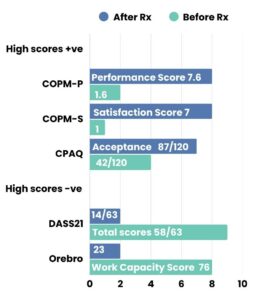
The Canadian Occupational Performance Measure (COPM)9 showed a 6-point improvement in performance and 6.6 in satisfaction (improvements of ≥2 points are considered clinically significant).
The COPM is an evidence-based outcome measure designed to capture a client’s self-perception of performance in everyday living, over time. Individuals are required to identify and prioritize everyday issues that restrict their participation in everyday living. This measure focuses on occupational performance in all areas of life, including self-care, leisure, and productivity. 9
The Örebro Musculoskeletal Pain Screening Questionnaire (OMPSQ Short-form)10 score improved significantly from 76 (2023) to 23 (2025) where >50 scores indicate a higher estimated risk for future work disability. (Linton, Nicholas & MacDonald, 2011) Interestingly, when her work disability score reduced, she made a decision to semi-retire.
DASS-2111 scores for depression (19), anxiety (19) and stress (20) all fell in the extremely severe disturbance range. These changed to normal depression (4) and anxiety (5) and mild disturbance stress (5).
The DASS-21 is a quantitative measure of distress along the 3 axes of depression, anxiety, and stress. Emotional syndromes like depression and anxiety are intrinsically dimensional – they vary along a continuum of severity (independent of the specific diagnosis).
Chronic Pain Acceptance Questionnaire (CPAQ)12 scores changed from 42/120 (35%) to 87/120 (72.5% ) with higher scores indicating higher levels of acceptance. Of note is that her activity engagement (pursuit of life activities regardless of pain) score change was extremely significant from 11/66 to 55/66. However, her pain willingness (recognition that avoidance and control are often unworkable methods of adapting to chronic pain) score had minimal change from 31/54 to 32/54.
The acceptance of chronic pain is thought to reduce unsuccessful attempts to avoid or control pain and thus focus on engaging in valued activities and pursuing meaningful goals.
Other self-reported outcomes
Belle reported reduced alcohol use, medication reliance, pain intensity, and neuro-arousal, alongside improved mental health, self-esteem, and energy.
She also noted that occupational therapy enabled progress in other modalities, for example advancing physiotherapy from stretching to strength training, and enhancing her psychological strategies for post-traumatic stress disorder.
DISCUSSION
This case illustrates the clinical value and centrality of occupational therapy in addressing disruption to meaningful occupations that can contribute to and perpetuate chronic pain. A personally-meaningful rehabilitation approach, defined as client-determined, identity-relevant, and supported by a strong therapeutic relationship with a credible therapist, has potential to support positive changes in a person’s pain experience and life satisfaction. Occupational therapists are essential contributors to multidisciplinary teams managing chronic pain.
Clinical impact
Key implications include:
- It is important for multidisciplinary teams to shift their focus beyond pathology to holistic, meaningful occupational outcomes.
- Occupational therapy can make an important contribution for clients to achieve meaningful goals and to enable greater progress across other treatment modalities.
- An emphasis on personally-meaningful rehabilitation has potential as a driver of sustainable change in chronic pain management.
*pseudonym
REFERENCES
- McCracken, L. M., & Vowles, K. E. (2008). A prospective analysis of acceptance of pain and values-based action in patients with chronic pain. Health Psychology, 27(2), 215–220.https://doi.org/10.1037/0278-6133.27.2.215
- Hitch, D., Pépin, G., & Stagnitti, K. (2014). In the footsteps of Wilcock, part two: The interdependent nature of doing, being, becoming, and belonging. Occupational Therapy in Health Care, 28(2), 110–123. https://doi.org/10.3109/07380577.2014.898115
- Hitch, D., Pepin, G., & Stagnitti, K. (2018). The pan occupational paradigm: Development and key concepts. Scandinavian Journal of Occupational Therapy, 25(1), 27–34. https://doi.org/10.1080/11038128.2017.1337808
- Wilcock, A.A. (1999), Reflections on doing, being and becoming. Australian Occupational Therapy Journal, 46: 1-11. https://doi.org/10.1046/j.1440-1630.1999.00174.x
- Brown, C. A. (2006). Reconceptualizing chronic pain as a complex adaptive system. Emergence: Complexity and Organization, 8(3), 2-11. https://doi.org/10.17357.72b9187d25178790f2c0ff3d0d82259b
- Liddiard, K. J., Raynor, A. J., DeJong, H., & Brown, C. A. (2022). The experience of meaningful rehabilitation as perceived by people with chronic pain: A phenomenological study. Work, 1-13. https://doi.org/10.3233/WOR-220119
- Ikiugu, M. N. (2005). Meaningfulness of occupations as an occupational-life-trajectory attractor. .Journal of Occupational Science, 12(2), 102-109. https://doi.org/10.1080/14427591.2005.9686553
- Human Flourishing Program. (2025).Human flourishing: An introductory framework (Report). Harvard University.
https://hfh.fas.harvard.edu/sites/g/files/omnuum8886/files/2025-05/2025%20Brochure_Compressed%20for%20website_Human%20Flourishing%20Program_single%20pages.pdf - Law, M., Baptiste, S., McColl, M.,Opzoomer, A., Polatajko, H., & Pollock, N. (2014). Canadian Occupational Performance Measure (5th ed.). CAOT Publications.
- Linton, S. J., & Boersma, K. (2003). Early identification of patients at risk of developing a persistent back problem: The predictive validity of the Örebro Musculoskeletal Pain Questionnaire. Clinical Journal of Pain, 19(2), 80–86. https://doi.org/10.1097/00002508-200303000-00002
- Lovibond, S. H., & Lovibond, P. F. (1995). The structure of negative emotional states: Comparison of the Depression Anxiety Stress Scales (DASS) with the Beck Depression and Anxiety Inventories. Behaviour Research and Therapy, 33(3), 335–343. https://doi.org/10.1016/0005-7967(94)00075-U
- McCracken, L. M., Vowles, K. E., & Eccleston, C. (2004). Acceptance of chronic pain: Component analysis and a revised assessment method. Pain, 107(1–2), 159–166. https://doi.org/10.1016/j.pain.2003.10.012